


 By
By 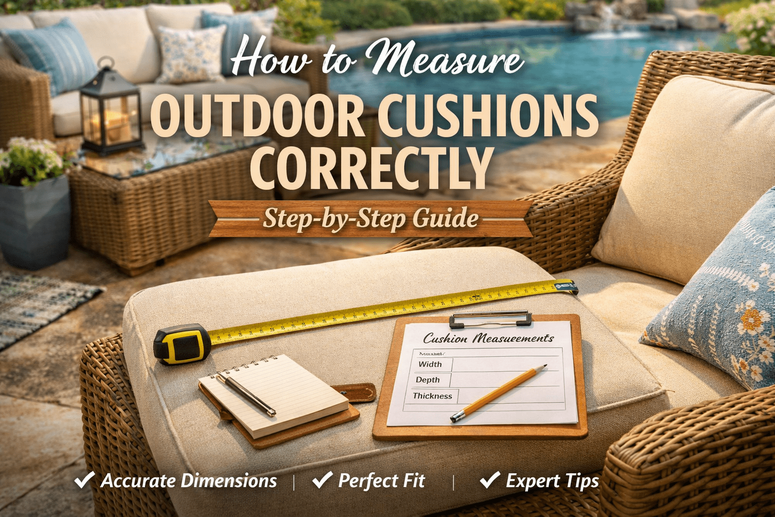
replacement cushions for outdoor furniture—accurate fit, fewer mistakes, better comfort." />
Replacement Cushions • Outdoor Cushions • Measuring Guide
How to Measure Outdoor Cushions Correctly (Step-by-Step)
Measuring is the difference between “perfect fit” and “almost fits.” If you’re ordering replacement cushions for outdoor furniture, this guide shows exactly how to measure—so your cushions sit cleanly, look tailored, and feel comfortable for years.
Expert note: At Wicker Paradise, we’ve been helping customers choose quality wicker furniture since 1982. One of the most common causes of “wrong cushion fit” is not the cushion—it’s the measuring method.
If you want a second set of eyes, call us and we’ll help you confirm measurements before you place an order. Contact Wicker Paradise.
Key definitions (so we measure the same way)
Cushion measurements sound simple—until you see a seat that tapers, a back that curves, or a cushion that’s compressed from years of use. These definitions keep your replacement cushions order accurate.
- Width: Left-to-right measurement across the furniture frame opening.
- Depth: Back-to-front measurement of the seat area (where you sit).
- Back height: Seat deck (the base where the cushion sits) up to the top of the frame, or the intended back support area.
- Thickness (loft): How tall the cushion is when new (commonly 3"–6"+ depending on style).
- Seat deck: The surface the seat cushion rests on (often wicker/rattan, slats, or a support panel).
- Inside frame: The “true” opening the cushion must fit within (this matters more than your old cushion size).
In real homes, cushions compress, edges soften, and corners round off. That’s why we’ll keep coming back to one theme: measure the furniture frame, not the cushion that’s worn-in.
Tools you’ll need
You don’t need anything fancy. You do need accuracy.
- Rigid tape measure (or a quality flexible tape, used carefully)
- Notepad (or notes app) to record measurements clearly
- Painters tape (optional) to mark the seat deck edges
- Camera (optional) for quick reference photos of the frame and shape
- Helper (optional) if you’re measuring a large sofa or sectional
Want extra confidence in fabric color and texture before you order? Consider swatches: Order Fabric Swatches.
The golden rule: measure the frame, not the old cushion
The most common measuring mistake is using the old cushion as “truth.” But old outdoor cushions compress, warp, and shrink in ways you can’t see until you compare them to the frame.
| Measuring Method | Pros | Cons | Best For |
|---|---|---|---|
| Measure the furniture frame | Most accurate fit; accounts for true opening | Takes a few extra minutes | All replacement cushion orders |
| Measure the old cushion | Fast; easier on paper | Often wrong due to compression & sagging | Only as a secondary reference |
If you prefer a quick visual walkthrough, we also have a measuring video guide: How to Measure Cushions the Right Way.
Step-by-step: how to measure a seat cushion
Seat cushions drive comfort, posture, and how “tailored” your furniture looks. These steps work for wicker, rattan, and premium outdoor frames from brands like Lane Venture, Lloyd Flanders, Braxton Culler, and more.
Step 1: Clear the seat deck
Remove the old cushion. Look at the actual seat area where the cushion sits. This is the surface your new cushion must fit.
Step 2: Measure seat width (inside the frame)
- Measure inside the frame from left to right at the seat opening.
- Record the measurement to the nearest 1/4 inch.
- If the seat narrows, measure front width and back width.
Pro tip: Tapered seats are common in outdoor dining and some lounge collections. Recording both widths prevents a cushion that binds at the back or floats at the front.
Step 3: Measure seat depth (back to front)
- Measure from the back support point (where the cushion touches the back frame) to the front edge of the seat deck.
- Stay level—don’t follow curves. Measure in a straight line.
- Record the depth to the nearest 1/4 inch.
Step 4: Identify the seat shape
Before you move on, identify what you have. Shape changes how you measure and how the cushion is cut.
- Square/Rectangular: Most chairs, loveseats, sofas
- Trapezoid/Tapered: Narrower at the back or front
- T-cushion: Extends forward around the arms
- Rounded corners: Common on premium lounge sets
- Curved front: Some wicker and rattan silhouettes
Step 5: Record thickness reference (optional but helpful)
If you liked the original “seat height,” measure your old cushion thickness at the center. Treat this as a reference only—new foam will feel fuller than aged foam.
What experts say: A clean-fitting seat cushion typically has a small amount of clearance so it doesn’t bind against the frame. Overly tight cushions wrinkle, “mushroom,” or wear faster along the seams.
Step-by-step: how to measure a back cushion
Back cushions influence posture and comfort. If the back is too tall, it can look bulky. Too short, and it won’t provide support where you need it.
Step 1: Measure back height (seat deck to top of frame)
- Measure from the seat deck straight up to the top of the back frame (or to the height you want the cushion to reach).
- Record to the nearest 1/4 inch.
Step 2: Measure back width at the shoulders
- Measure the inside width where the back cushion will sit (often near the “shoulder” area).
- If the back curves, measure at the widest point and note the curve.
Step 3: Note special back details
- Curved backs: Note whether the frame curves inward or outward.
- Wings: Some designs have side wings that change cushion shape.
- Tufting/buttons: If you want a tufted back, note that it changes the look and sometimes the feel.
If you’re ordering for a known collection, product pages often list exact dimensions to cross-check. Example: many Lloyd Flanders cushion pages provide detailed measurements for seat and back pieces. Explore Replacement Cushions.
How to choose thickness (loft) without guesswork
Thickness affects comfort, seat height, and how “premium” the cushions look. A thicker cushion can feel more luxurious—but it can also raise your seated position and change how your arms rest.
Typical thickness ranges
- Dining seat cushions: ~2"–3" (easy to sit upright, clean silhouette)
- Lounge seat cushions: ~4"–6" (plush, relaxed comfort)
- Deep seating / sectional: ~5"–7"+ (modern “sink-in” comfort)
- Back cushions: often ~4"–6" depending on style and fill
The comfort tradeoff (simple rule)
- If you want a tailored, upright sit, choose a moderate thickness.
- If you want a plusher, lounge feel, go thicker—especially for seat cushions.
Many premium outdoor cushions also offer performance options (like faster-drying constructions). If you’re selecting cushions for rain, pool areas, or humid climates, ask about quick-dry approaches before you order.
Measuring common cushion shapes (so you don’t get surprised)
Shape is where “standard measuring” breaks down. Here’s how to handle the most common outdoor cushion shapes—especially on higher-end sets.
T-cushions (wrap around the arms)
A T-cushion extends forward on one or both sides. It’s common on classic outdoor seating because it looks tailored and maximizes seating area.
- Measure the main seat width inside the frame.
- Measure the depth normally (back to front).
- Measure the T extension length (how far it projects forward around the arm).
- Measure the T width (the width of that extension area).
Trapezoid / tapered seats
- Measure front width.
- Measure back width.
- Measure depth at the center line.
Record both widths clearly. This is one of the easiest ways to avoid a cushion that “fits” at one edge and gaps at the other.
Rounded corners / curved fronts
- Measure the maximum width and maximum depth.
- Note the radius or take a photo showing the curve.
- If the front is curved, measure depth at left, center, and right.
Chaise lounges
- Measure total cushion length along the frame.
- Measure width inside the frame at multiple points (front/middle/back).
- If the chaise has a backrest cushion separately, measure it like a back cushion section.
If you’re replacing cushions for a specific brand collection (Lane Venture, Lloyd Flanders, NorthCape, etc.), you may be able to order by the exact collection sizing—especially when the cushions were standardized by the manufacturer. Explore brand cushion collections here: Replacement Cushions by Brand.
Rounding rules: when to round up vs. down
The right rounding rule depends on how the cushion is designed to sit in the frame. Here are simple, practical guidelines that reduce fit issues.
| Scenario | Recommendation | Why |
|---|---|---|
| Inside-frame seat cushion (most common) | Round down slightly if between sizes | Prevents binding, wrinkling, seam stress |
| Loose “bench” style cushion | Match the frame; consider rounding up for a fuller look | A touch fuller can look more tailored |
| Back cushion in an open frame | Avoid oversizing; stay true to the frame and comfort target | Too large looks bulky and can push you forward |
When in doubt, record your exact measurement to the nearest 1/4 inch and ask for guidance before ordering. We’re happy to help: Contact Us.
Quick measurement checklist (print-friendly)
- ✅ Measure the frame (not the old cushion)
- ✅ Record seat width (inside frame)
- ✅ Record seat depth (back to front)
- ✅ If tapered: record front width + back width
- ✅ Identify shape: square, trapezoid, T-cushion, curved, rounded corners
- ✅ Record back cushion height (seat deck to top of frame)
- ✅ Record back cushion width (inside frame at shoulders)
- ✅ Decide thickness based on comfort + seat height preference
- ✅ Take 1–2 photos of the frame and shape (optional but helpful)
Top mistakes that cause “doesn’t fit”
These are the issues we see most often when customers come to us for outdoor replacement cushions. Avoid them, and you’ll avoid almost all fit problems.
- Mistake #1: Measuring old cushions that are compressed.
- Mistake #2: Measuring outside-to-outside instead of inside the frame.
- Mistake #3: Ignoring taper (front width ≠ back width).
- Mistake #4: Not noting special shapes like T-cushions or curved fronts.
- Mistake #5: Choosing thickness without considering seat height and arm height.
- Mistake #6: Assuming “close enough” is fine—small differences can cause wrinkling or binding.
If your goal is “looks original, feels upgraded,” the best approach is accurate measuring + premium fabric and construction. Start browsing by category: Replacement Cushions for Chairs & Rockers.
Brand replacement cushions vs. custom sizing
Some customers already know their furniture brand and collection. Others have older sets or inherited furniture with no tags. Either way, you have options.
When brand-specific cushions make sense
- You own a recognized collection and want factory-style fit.
- Your frame matches known dimensions (often listed on product pages).
- You want the look to match the original silhouette.
Explore brand collections here: Lane Venture Replacement Cushions, Braxton Culler Replacement Cushions, and our full hub: Replacement Cushions.
When “pick your size” / custom sizing is the better move
- Your furniture is an older set with unknown specs.
- Your cushions were altered over the years.
- You want to adjust thickness or comfort level.
If you already have clean, accurate measurements and want a straightforward ordering path, you can start here: Pick Your Size Chair Replacement Cushion Set.
Seasonal tip: Spring and summer ordering seasons can increase lead times for made-to-order cushions. If you’re refreshing for warm weather, measuring and ordering early helps you enjoy the season sooner.
Want help confirming sizes before you order? Call or email us here.
FAQ: Measuring Replacement Cushions (Featured Snippet Ready)
Should I measure my old cushions or my furniture frame?
Measure the furniture frame. Old cushions compress and can be misleading, which often leads to cushions that don’t fit correctly.
How do I measure a seat cushion for outdoor furniture?
Remove the cushion and measure inside the frame: width (left to right) and depth (back to front). If the seat tapers, measure front width and back width.
How do I measure a back cushion?
Measure back height from the seat deck to the top of the frame (or desired cushion height), and measure inside width at the shoulders where the cushion will sit. Note any curves or wings.
What thickness should I choose for outdoor replacement cushions?
Dining cushions are typically 2"–3". Lounge cushions are commonly 4"–6"+. Choose thickness based on your comfort preference and how high you want to sit.
What if my cushion shape is curved or a T-cushion?
Measure maximum width and depth, then measure additional shape details (like the T extension). Take a photo of the frame to document curves and unique cut lines.
Can Wicker Paradise help me confirm measurements before I order?
Yes. If you want confidence before placing an order, contact us and we’ll help confirm the measurements and the best approach for your furniture. Contact Us.
Suggested internal links (with anchor text ideas)
- Replacement Cushions — anchor ideas: “replacement cushions”, “shop replacement cushions”, “outdoor replacement cushions”
- Lane Venture Replacement Cushions — anchor ideas: “Lane Venture replacement cushions”, “Lane Venture cushions”
- Braxton Culler Replacement Cushions — anchor ideas: “Braxton Culler replacement cushions”, “Braxton Culler cushions”
- Replacement Cushions for Chairs & Rockers — anchor ideas: “chair replacement cushions”, “outdoor chair cushions”
- Pick Your Size Chair Replacement Cushion Set — anchor ideas: “pick your size cushions”, “custom size chair cushions”
- Order Fabric Swatches — anchor ideas: “order swatches”, “Sunbrella swatches”, “fabric samples”
- How to Measure Cushions the Right Way (Video) — anchor ideas: “measuring video”, “how to measure cushions”
- FAQ — anchor ideas: “replacement cushion measuring FAQ”, “common cushion questions”
- Contact Us — anchor ideas: “talk to a cushion expert”, “confirm measurements”
Suggested image filenames + SEO alt text
-
how-to-measure-replacement-cushions-seat-width-depth.jpg
Alt: “Measuring seat width and depth on outdoor furniture frame for replacement cushions” -
measure-back-cushion-height-outdoor-chair.jpg
Alt: “How to measure back cushion height from seat deck to top of frame” -
t-cushion-measurement-diagram-outdoor-sofa.jpg
Alt: “T-cushion measurement points for outdoor sofa replacement cushions” -
tapered-seat-trapezoid-cushion-measure-front-back-width.jpg
Alt: “Measuring a tapered trapezoid seat: front width and back width for outdoor cushions” -
rounding-rules-round-up-round-down-replacement-cushions.jpg
Alt: “Rounding rules for cushion sizing: when to round up or down for perfect fit”
Ready to refresh your furniture? Explore our collection of premium replacement cushions and choose performance fabrics designed for outdoor living. If you’re ordering for spring and summer, measuring early can help you stay ahead of seasonal lead times.